Course Menu
-
Introduction
Course Outline
System Development
Understanding Fear Paralysis Reflex
Understanding Moro Reflex
Understanding Rooting Reflex
Understanding Babinski Reflex
Understanding Palmer Reflex
Understanding Spinal Galant Reflex
Understanding Tonic Labyrinthine Reflex (TLR)
Understanding Symmetrical Tonic Neck Reflex (STNR)
Understanding Asymmetrical Tonic Neck Reflex (ATNR)
-
Phase 1 Overview
Rhythmic Movement Training
Rooting Reflex Exercise
Palmar Reflex Exercise
Babinski Reflex Exercise
Spinal Galant Reflex Exercise
Moro Reflex Exercise
Optokinetic Reflex
Astronaut Training Slow
Wilbarger Brushing
Box Breathing
Hand Pulls
Meatball
Smooth Pursuits
Supine Rocking
1/2 Superman
Snow Angel
BALANCED BRAIN ~ THRIVING CHILD
Kim Lowack
Convergence
Technique:
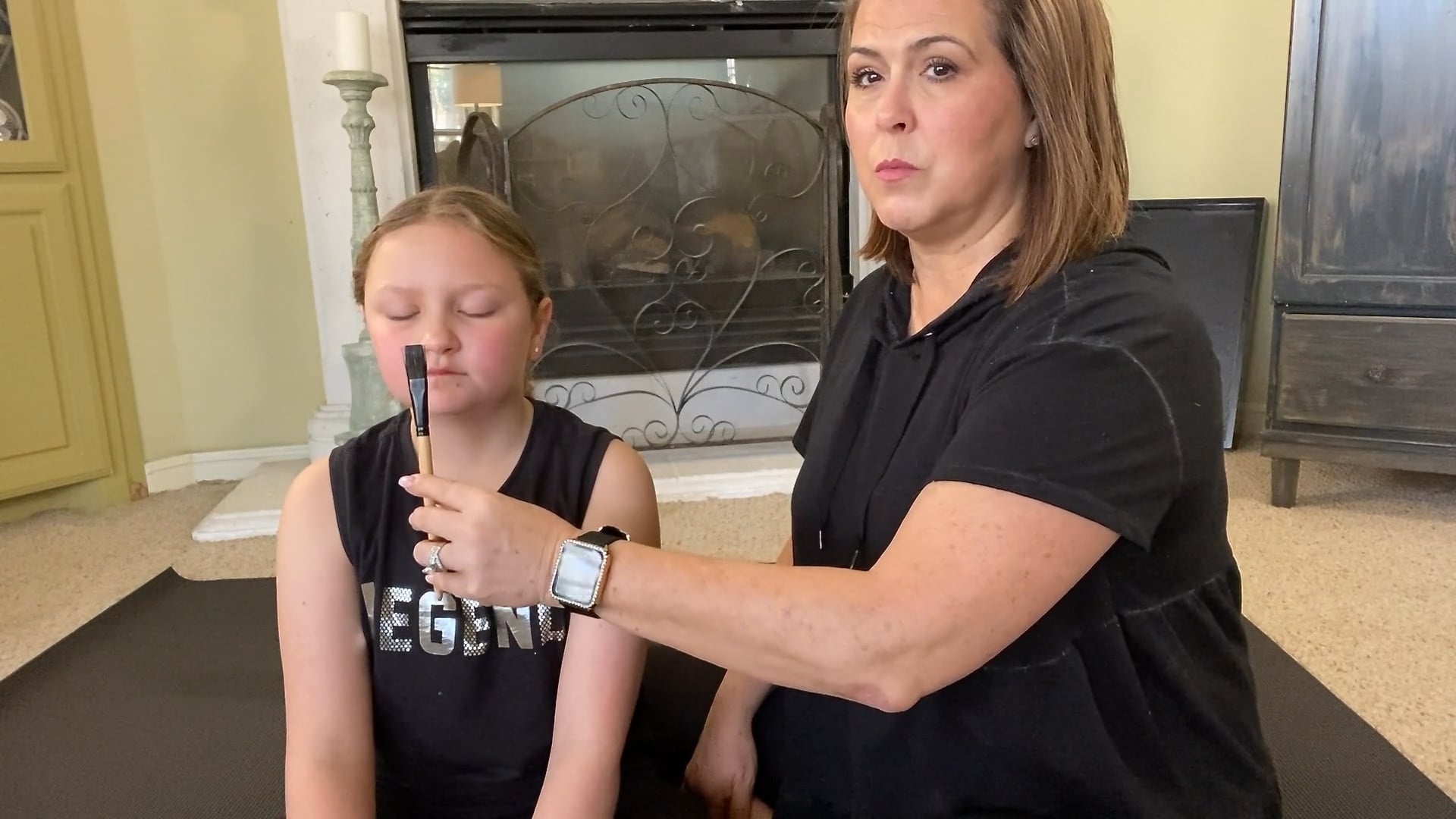
- Slowly move an object from about 12 inches from the nose toward the nose.
- Watch to see that the eyes move at the same time such that they cross at the same time and synchronize. We want them to continue in unison on the way out as well.
- When you get the eyes to a point that they are equal in movement, stop and have the child hold that position for 3-5 seconds before moving forward.
- Gradually decrease the distance from the nose until they have crossed eyes equally as you are touching their nose.
Frequency:
- 1-2 x daily
- 6 cycles (in and out is 1 cycle)
- give rest breaks as needed, the eyes can be very sensitive. This activity may take months to get full results.
Undesired observations:
- One eye moves without the other
- Neither eye moves inward toward the nose
- Both eyes move in but one will wander back out
- Holding breath
- Watering eyes
- Eye strain
- Eye aches
- Headache
Additional Convergence Training Methods: when instructed by your coach
Brock string - Amazon Link
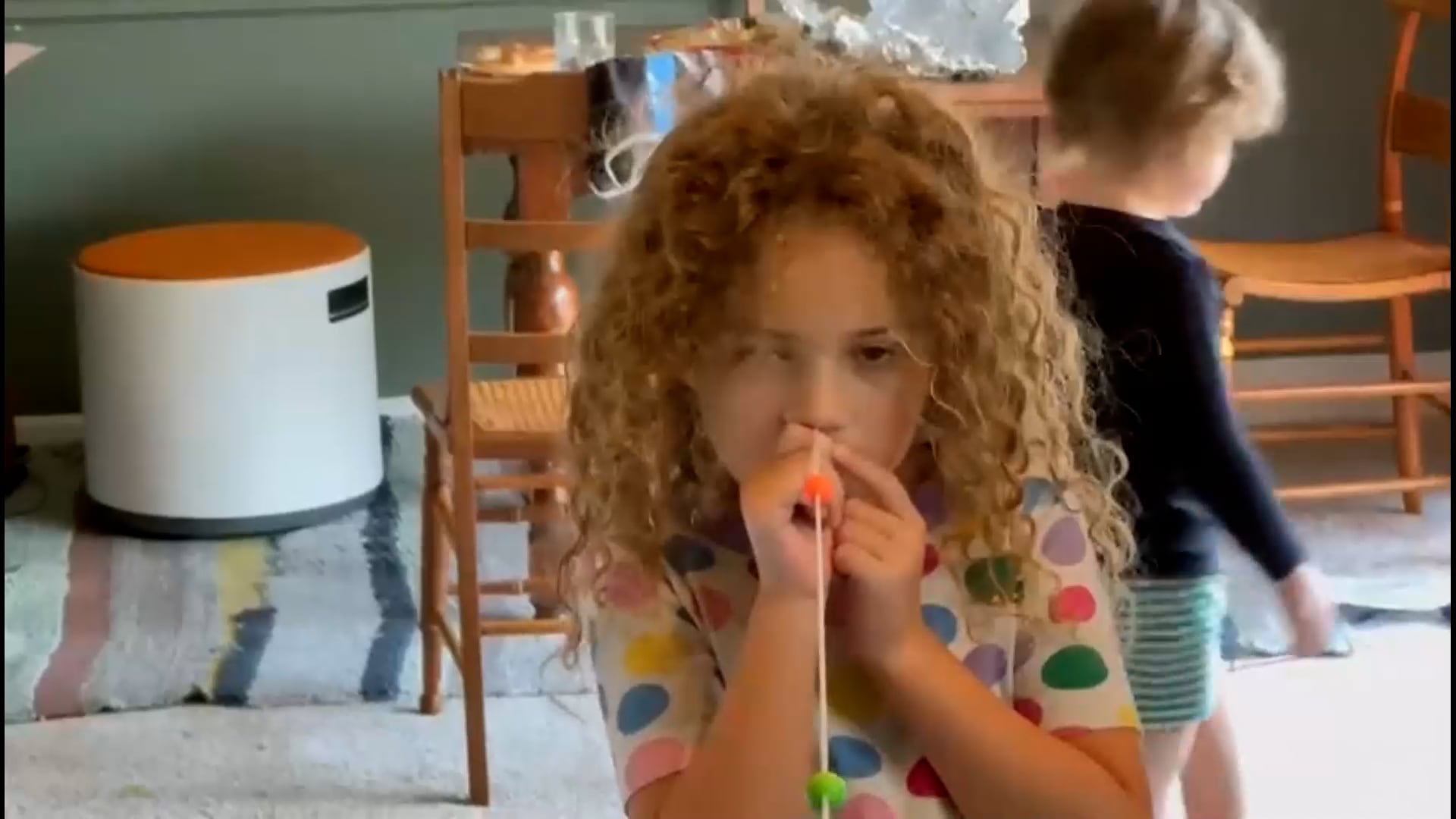
The Brock string is a 10- to 15-foot white string containing several colored beads.
This is the training of convergence and suppression. Suppression is when the brain ignores visual signals from one eye to avoid double vision.
This exercise aims to improve binocular vision, eye teaming, and eye coordination at all distances.
To perform this exercise:
- Hold either end of the Brock string in either hand.
- Hold one end of the Brock string near the nose and stretch the string out in front.
- Place the beads at 3", 6", 12" and 18 " and at the end of the string.
- Look at the closest bead. It should appear as one bead with an V string behind it
- Look at the second bead. The strings should form an X in front of and behind the bead, with the bead in the middle. For a person with a convergence problem, the bead focused on will appear double.
- Slowly switch the focus from one bead to the next, making sure that the bead focusing on is at the center of the X pattern. A person should properly focus on the bead to keep seeing the X pattern, except for the one at the far end, it should appear as a sing bead with an V in front.
Barrel cards - Amazon Link
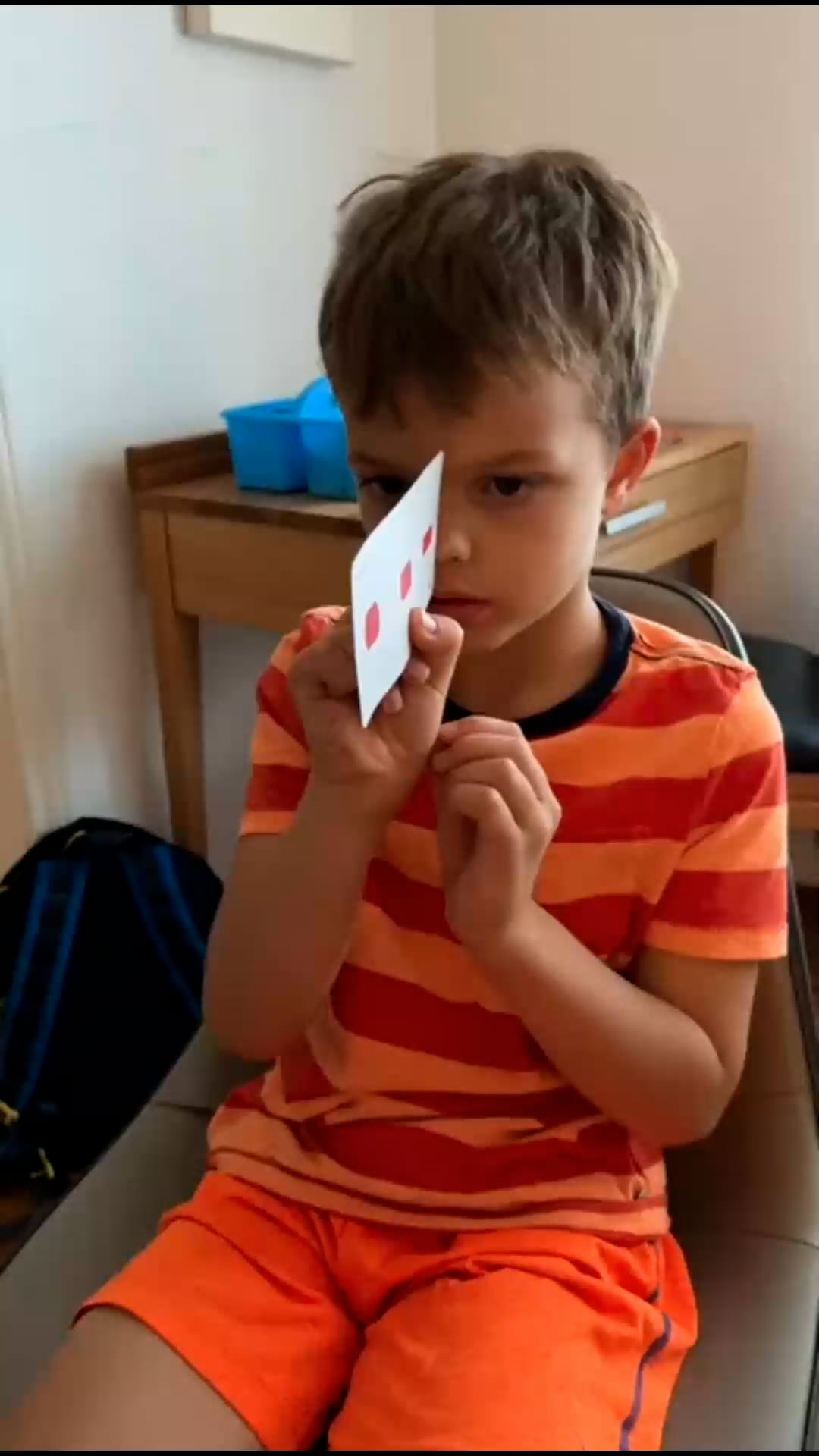
Barrel cards aim to train convergence and reduce suppression.
The cards feature three red and green targets opposite each other. To use these cards:
- Hold the card lengthwise against the nose, with the largest barrel farthest from the face.
- Focus on the largest barrel until you see two colored sides of one shape. The red should appear on the left side and the green should appear on the right side (opposite than what they are on the card)
- Maintain the focus for 5 seconds before switching to the middle shape and then again on the closest shape.
- Observe if both eyes are moving equally in towards the nose as they are converging.
Definition:
Convergence insufficiency is an eye condition that affects how your eyes work together when you look at nearby objects. This can cause blurry or double vision when you look at things up close, like a book or a smartphone screen. This motor skill dysfunction is very commonly linked to unintegrated reflexes especially the ATNR and TLR and STNR reflexes.
People with convergence insufficiency often have vision problems when they do close-up activities, like reading or using a computer. The most common symptoms are:
- Tired or sore eyes
- Blurry vision
- Double vision
- Headaches
- Trouble concentrating
Normally when you focus on something up close, both of your eyes turn in. When people with convergence insufficiency look at something up close, 1 eye turns out or neither eye turns in.
They may also have trouble reading. They might lose their place, read slowly, or feel like the words move or float around on the page.
If your child has convergence insufficiency, you may notice that they have problems when they read or do other close-up activities. They may:
- Squint
- Rub their eyes
- Close 1 eye
Parents and teachers might think kids with convergence insufficiency have trouble reading or learning — but it’s actually a vision problem that needs to be treated. Convergence is closely linked to an unintegrated TLR, ATNR and STNR reflex and Rooting reflex.
Convergence Insufficiency - one eye
Convergence Insufficiency - both eyes
Brock String
Barrel Card